
Choosing the right grass for a North Texas lawn is about more than picking the variety that looks best when it is freshly installed. Mansfield homeowners need turf that can handle summer heat, seasonal weather changes, foot traffic, watering needs, and the amount of sunlight their yard receives.
That is why the Bermuda grass vs St Augustine grass in Mansfield TX comparison is so important. Both are warm-season grasses commonly used in Texas, but they perform differently once installed.
Bermuda grass generally performs best in sunny, active yards where durability matters. St. Augustine grass is often better suited to lawns with partial shade and homeowners who prefer a wider, coarser grass blade.
Neither option is automatically right for every property.
Ridgeview Landscape helps Mansfield homeowners evaluate lawn conditions and select turf based on the actual property instead of choosing grass based only on appearance. Professional sod installation services can also help ensure the lawn is properly prepared before new grass is installed.
For homeowners comparing St Augustine grass vs Bermuda, the biggest differences involve sunlight, shade tolerance, traffic, appearance, and maintenance.
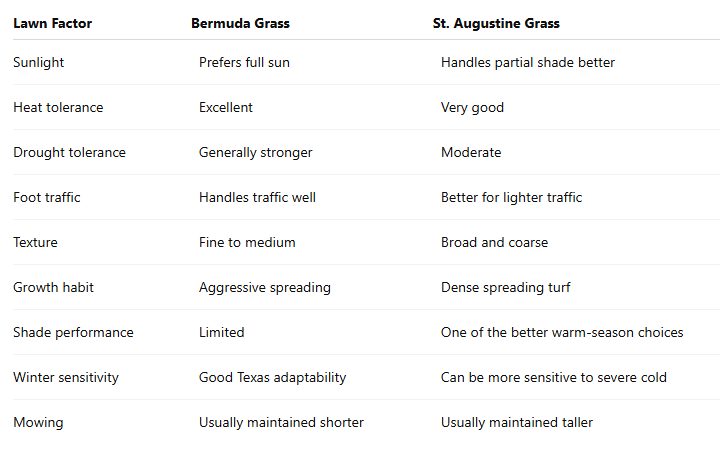
These differences provide a useful starting point, but soil, irrigation, drainage, and landscape design should also influence the final decision.
Bermuda grass is widely used throughout Texas because it handles heat, sunlight, and active use well.
It spreads through both above-ground and below-ground growth, helping it recover from moderate wear and fill damaged areas during its active growing season.
Sunlight is one of the most important factors when choosing Bermuda.
It performs best in lawns that receive plenty of direct sunlight. Large shade trees, closely spaced homes, fences, or covered outdoor areas can make Bermuda thin over time if sunlight becomes too limited.
For higher-value residential properties where a clean, uniform lawn is an important part of curb appeal, properly installed Bermuda can create a neat and refined appearance.
One major advantage in the Bermuda grass vs St Augustine grass comparison is durability.
Bermuda is commonly chosen for areas that experience regular activity because it has strong recovery potential during warm growing conditions.
That can make it attractive for:
However, even durable grass needs suitable soil and irrigation to remain healthy.
St. Augustine offers a noticeably different lawn appearance.
Its broad blades create a thick, lush surface, and its improved shade tolerance makes it useful for properties where Bermuda may struggle.
For homeowners asking which is better St Augustine vs Bermuda grass in a yard with mature trees, St. Augustine often deserves stronger consideration.
It is one of the most shade-tolerant warm-season turf options commonly used in Texas.
That does not mean it can grow in complete darkness. All turf requires light. However, St. Augustine can often perform better than Bermuda where direct sunlight is reduced.
If your yard includes trees, planting beds, patios, or other features that create changing sun patterns, a complete property assessment can be useful before choosing sod.
Ridgeview Landscape's landscape design services can help homeowners plan turf, planting areas, and outdoor features together.
Both grasses are warm-season turf types and are adapted to hot climates.
Bermuda, however, is especially well known for heat and drought tolerance. Once established, it can handle periods of moisture stress better than many other residential turf choices.
St. Augustine also performs well during Texas summers when it receives appropriate irrigation, but maintaining consistent moisture becomes more important.
This is an important part of any DFW lawn grass comparison because July and August conditions can place significant stress on residential landscapes.
Drought tolerance does not mean a lawn never needs water.
A healthy lawn still requires appropriate irrigation based on:
Homeowners concerned about coverage can review Ridgeview Landscape's sprinkler services when planning a new sod project.
Maintenance requirements depend partly on how polished you want the lawn to look.
Bermuda grows aggressively during warm weather and generally responds well to regular mowing.
Homeowners should expect to:
Its rapid growth can be an advantage because damaged areas may recover relatively quickly.
St. Augustine is normally maintained at a taller height than Bermuda.
It can produce a thick lawn, but homeowners should watch irrigation carefully because excessive moisture and poor airflow can contribute to lawn problems.
Proper mowing, watering, and fertilization are important for both grasses.
This category has a clearer difference.
St. Augustine generally performs better in partial shade than Bermuda.
Bermuda relies heavily on sunlight to maintain dense turf. When planted in areas with insufficient light, it may become thin and leave space for weeds or bare soil.
St. Augustine can tolerate more shade, although heavily shaded locations may still be unsuitable for turf.
In areas where even St. Augustine struggles, homeowners may be better served by extending a flower bed, using mulch, or redesigning that portion of the landscape instead of repeatedly replacing grass.
Bermuda usually has the advantage for active lawns.
Its durability and ability to recover from wear make it suitable for backyards that receive frequent use.
St. Augustine can handle normal residential activity but is less suited to repeated heavy traffic.
If the lawn regularly hosts:
Bermuda may be the more practical candidate, provided the yard receives enough sunlight.
There is no single best type of grass for North Texas because properties can have completely different growing conditions even within the same neighborhood.
A sunny Mansfield front yard may favor Bermuda, while a backyard surrounded by mature trees may be better suited to St. Augustine.
Before selecting grass, evaluate:
Watch the yard throughout the day rather than checking only once.
Compacted or uneven soil should be corrected before new turf is placed.
Ridgeview Landscape offers grading services when a property needs leveling or soil preparation before landscape installation.
Grass performs poorly when water consistently collects in low spots.
Properties with standing water or runoff problems may require landscape drainage improvements before sod installation.
Consider whether the yard is mainly decorative or frequently used by children, pets, and guests.
A beautiful lawn still requires mowing, irrigation, fertilization, and seasonal attention.
A simple way to narrow the decision is to start with the biggest limitation on your property.
Choose Bermuda when your lawn has:
Consider St. Augustine when your lawn has:
The grass should fit the property rather than forcing the property to fit the grass.
Even the right grass can struggle if it is installed over compacted soil, poor grading, drainage problems, or an improperly prepared surface.
Ridgeview Landscape works with homeowners throughout Mansfield and the surrounding DFW area to evaluate these conditions before installation.
You can view examples of local outdoor transformations in the Ridgeview Landscape project gallery and review customer experiences through the Ridgeview Landscape Google Business Profile.
If you are still comparing Bermuda grass vs St Augustine grass in Mansfield TX, an on-site lawn evaluation can make the decision much easier.
Contact Ridgeview Landscape to request a quote and discuss which sod variety fits your Mansfield property.
Neither is universally better. Bermuda usually performs better in sunny, high-traffic lawns, while St. Augustine is typically more suitable for areas with partial shade. Your property's sunlight, soil, irrigation, and intended use should guide the decision.
Yes. Bermuda is well adapted to Texas conditions and performs particularly well in sunny areas. Its heat tolerance, drought tolerance, durability, and ability to recover from traffic make it popular for North Texas lawns.
St. Augustine can perform well in Mansfield when installed in suitable conditions. Its main advantage is shade tolerance, although it generally requires more consideration for cold exposure and moisture management than Bermuda.
Established Bermuda generally has stronger drought tolerance than St. Augustine. Actual irrigation needs vary according to soil, weather, shade, root development, and lawn management.
Bermuda is often a better candidate for active dogs because it handles traffic and recovers from wear well. However, it needs sufficient sunlight. A shaded dog run may require another landscape solution.
Bermuda can struggle when tree canopies create significant shade. St. Augustine generally performs better with partial shade, although extremely shaded areas may not support either grass successfully.
Both can create an attractive lawn when matched to the property and maintained properly. Bermuda offers a finer, manicured appearance, while St. Augustine produces broader blades and a thick, lush look.
New sod may be worthwhile when a lawn has extensive bare areas, incompatible grass varieties, serious weed problems, or widespread damage that would be difficult to repair. Ridgeview Landscape can evaluate the lawn before recommending replacement.


